

Real Estate Marketing Trends Agents Should Prepare for in 2027
Five structural shifts reshaping real estate marketing in 2027, including AI, stricter brokerage brand standards, vendor consolidation, and the new role of physical signage. Plus five moves to make before the spring market arrives.

The Year-End Planning Window
By November the markets have cooled and the calendar has wound down. It's the one stretch when you can step back and decide what your marketing should actually be built on. Wait until January and you'll be planning in the middle of the busiest season instead of ahead of it.
The trends shaping 2027 aren't a new app or a viral tactic. They're structural, and they're shifting at once: how buyers find properties, how brokerages enforce standards, and how agents buy their materials. Agents who read those shifts early won't have to scramble to catch up. If you want the groundwork first, our real estate agent marketing guide covers the fundamentals these trends build on.
Below are five trends to prepare for in 2027, plus the moves that put you ahead of each one before spring.
Offline and Digital Marketing Become One System
For years, agents ran their marketing as two departments. Signs and postcards lived in one world; the website, social, and CRM lived in another. A buyer could drive past your listing, see a panel with nothing but a phone number, then search online and land on a page that looked nothing like the sign in the yard. That gap is closing. Think about how a prospect actually moves: they notice your sign on an evening walk and scan a code from the sidewalk, look you up that night, then get a just-listed postcard a week later. To them it's one experience, and they don't care which parts you call offline.
Why the Curb Is Now the First Click
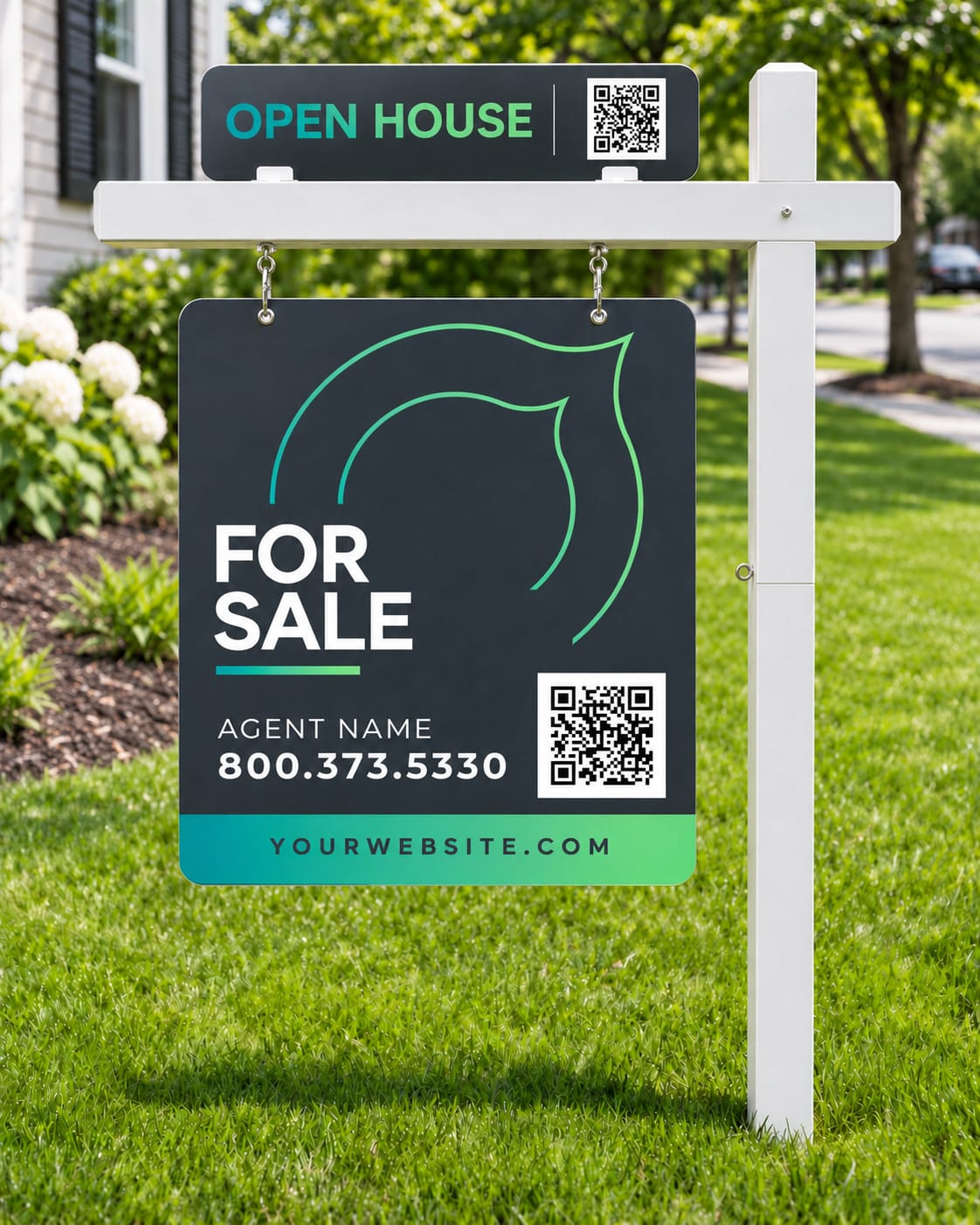
Your yard sign has quietly become the top of your digital funnel. It's often the first place a neighbor meets your name, and the next ten seconds decide whether that interest becomes a lead or disappears. A sign with only a name and number asks the viewer to do all the work. A sign built to connect, with a clear call to action or a scannable code, hands them an easy next step while curiosity is at its peak. If you're new to this, our guide to QR codes on real estate signs covers the practical setup.
A sign with no next step doesn't fail loudly. Nobody calls to tell you they saw your panel and gave up. The interest simply evaporates between the curb and the kitchen table, and you never learn it existed. Add a scannable path and that attention becomes traceable: how many people took the step, which riders get scanned, whether the traffic turns into conversations. That's the difference between a sign you hope works and a sign you can improve.
The way to prepare is to treat every physical piece as an entry point to your digital system, starting with high-visibility real estate panels that carry one clear call to action. Use custom sign riders to add a QR code, a property website, or a text code without redesigning the whole sign, and keep a stocked brochure box on every post for the people who prefer something in hand. When the physical piece and the digital follow-up look like the same brand, the prospect never feels the handoff.
AI Raises the Floor on Copy and the Ceiling on Differentiation
This is the shift most agents still underestimate, and it cuts two ways.
First, AI has moved from experiment to routine. NAR's 2026 Realtors Technology Report found that 23% of members use AI daily and 25% weekly, and among those users 75% write listing descriptions with it, 56% write social posts, and 52% handle email and follow-up. RPR's February 2026 survey of 225 agents put current use higher still, at 82%. The exact number depends on who you ask, but the direction doesn't. Competent listing copy is no longer an advantage. It's the floor.
Second, AI is changing how buyers find that copy. Google's AI Overviews now answer a large share of informational queries directly on the results page, and the click-through math has moved against publishers. Seer Interactive measured organic click-through on queries with an AI Overview falling from 1.76% to 0.61% between June 2024 and September 2025, and Define Media Group's analysis of 64 publisher sites found organic search clicks down 42% from the pre-Overviews baseline.
What That Means for a Local Agent
The more content AI generates and summarizes, the less a generic blog post or templated listing description separates you. What AI cannot manufacture is corroborated local presence: your name on ten corners in one subdivision, neighbors who recognize your sign, a brand that shows up consistently everywhere a buyer checks. As digital content becomes abundant and interchangeable, verifiable presence in the world becomes the scarce asset. The agents who own their farm areas already understand this; our breakdown of how agents build neighborhood market share shows what repetition actually buys you.
That's the case for the physical layer in 2027. Accuracy and compliance rank as agents' top two AI concerns, and neither is something you can proofread your way out of. The pieces you can audit, the sign in the yard and the brochure in the box, carry a credibility generated copy can't.
Stop treating AI as a substitute for your marketing and start treating it as the back office. Use it for copy and scheduling, then spend your differentiation budget on the layer that can't be automated. That starts with a matched system such as the Elite Agent Bundle rather than pieces bought one at a time.
Brokerage Brand Standards Get Stricter
As firms grow, merge, and enter new markets, the gap between the logo on the website and the sign in the yard gets harder to ignore. A brand that looks polished online but appears in five versions across one neighborhood loses the recognition it built. That's why more of the brokerages we work with are tightening requirements for colors, layouts, logo placement, and materials. For an agent, that can feel like a loss of creative freedom, but the shift isn't going away, and the ones who embrace it early get more out of it. We covered the wider version of this in redefining brokerage signage in a changing market.
Why Standards Work in Your Favor
A consistent brokerage brand gives you borrowed authority. When a homeowner sees the same clean design on a dozen yards across town, the brand starts to feel established, and that credibility transfers to every agent carrying it. Your personal brand doesn't disappear inside those standards; it rides on top of them. The agents who win find the room within the system to make their name memorable instead of fighting it.
The friction also shows up long before anyone inspects your sign. Ordering on your own usually means approximating the spec from memory or from a photo of a competitor's sign, and the approximation is what gets flagged. Ordering against a written guide removes the guesswork: colors, logo lockup, and name placement are already decided, so the only variable left is timing. Treat the guide as an ordering checklist and you spend far less time on proofs and corrections.
Align your inventory with your brokerage's standards now, including the directional signs that put your brand on every corner. Request the current guide, compare it to what's in your garage, and replace anything off-brand during the quiet months rather than mid-launch. If you lead a team, a custom storefront program gives every agent the same approved designs to order from, so consistency stops depending on memory.

Vendor Consolidation Simplifies the Marketing Stack
Look at how agents buy marketing today: panels from one supplier, riders from another, brochure boxes from a third, print from a local shop, directionals from whoever had them in stock last spring. Each order carries its own login, proofing process, lead time, and slightly different version of your brand. It works until it doesn't, and it usually breaks on the day a listing needs to launch. Brokerages have already moved toward fewer partners who handle more of the work, and that thinking is now reaching teams and individual agents.
The Hidden Cost of Too Many Suppliers
Every extra vendor adds friction you never see on an invoice: the blue that prints a shade off, the rider that arrives a week behind the panel, the third round of approvals on the same proof. Small annoyances individually, but together they slow launches, erode brand consistency, and pull hours away from the work that wins listings.
Consolidate your signage with a single partner that can deliver the full system, from complete agent bundles to individual replacement pieces. One source means one set of brand files, one proofing process, and materials that match from panel to brochure box. Reorders get faster too, because your specs are already on file when the next listing comes in. Fewer vendors doesn't mean fewer options; it means every vendor question has one answer.
Scalable Marketing Systems Replace One-Off Effort
Many agents still market each listing as if it were their first. A new listing arrives and the scramble starts: order the sign, book the photographer, design the flyer, remember where the directionals ended up. That survives two or three listings a year. It falls apart when three land in the same week. The agents building for 2027 think in systems instead of tasks, and they know exactly what every listing gets, in what order, and from whom.
Why Systems Outlast Busy Seasons
A system protects your brand when you're stretched thin. In the middle of spring, with showings, negotiations, and closings competing for your attention, the details that slip first are the marketing ones. A repeatable launch, with the same package and timeline, means every seller gets the same polished experience no matter how busy you are, and it makes onboarding an assistant far easier because the playbook already exists.
Define a standard listing package now, while you have time to think it through, and make solar sign lights part of it so every listing keeps working after dark. Write down what goes on every property: the panel, the post, the riders, the brochure box, four to six directionals, and a feather flag for open house weekends. If you're unsure which format fits which moment, our comparison of banners, flags, and signs lays out the trade-offs. Keep backup inventory so a damaged sign never delays a launch. When every listing gets the same treatment, marketing stops depending on how much energy you have that week and starts compounding.
The Year-End Audit: Five Moves Before Spring
You don't need to do all of this in December. You need to do it while the calendar still has room, and this is the window when most brokerages finalize their brand guidelines for the coming year. New logo versions, updated palettes, and revised sign specs tend to land in the last quarter, so check now rather than discovering the mismatch mid-listing.
- Print your brokerage's brand guide and audit your inventory against it. Retire anything faded, damaged, or off-brand now, not the week a listing goes live.
- Add one digital call to action to every sign. A QR code, a text code, or a property URL on a rider. One clear next step, not three.
- Add AI to the back office, not the front. Use it for drafts, scheduling, and follow-up, then protect the layer that still separates you: consistent physical presence.
- Write down your standard listing package. Panel, post, riders, brochure box, four to six directionals, one feather flag. Put it where an assistant could follow it without asking you.
- Cut your supplier list to one. Match the order to the brand guide once, then reorder from saved specs all year.
Build Next Year's Presence Before the Spring Rush
Every one of these shifts points the same direction: connected, consistent, consolidated, repeatable. Oakley Signs has supplied real estate agents with professional grade signage for decades and has worked with thousands of Realtors, teams, and brokerages who think the same way. Use this year-end window to put your system in place, and start 2027 with every listing ready to work. Browse the full range in our real estate signs shop.
Shop NowFrequently Asked Questions
What are the biggest real estate marketing trends for 2027?
Five structural shifts: offline and digital marketing converging into one system, AI becoming baseline rather than advantage, stricter brokerage brand standards, vendor consolidation toward single partner systems, and one-off effort giving way to standardized listing packages. Each rewards consistency over improvisation. The common thread is that as digital content gets cheap and abundant, verifiable physical presence becomes the differentiator.
How is AI changing real estate marketing?
It's already routine. NAR's 2026 report found 48% of Realtors using AI daily or weekly, with 75% of users writing listing descriptions with it. The practical effect is that competent copy is the floor rather than an advantage. Differentiation shifts to what AI can't generate: consistent local presence, recognizable signage, and a brand that looks the same everywhere a buyer checks.
What are good real estate marketing ideas for next year?
Audit your signage against your brokerage's brand guide and replace anything faded or off-brand during the slow months. Add a QR code or text-to-lead prompt to your signs and riders so curbside interest converts. Then define a standard listing package every property receives, flags included, and consolidate orders with one signage partner so reorders stay fast and consistent.
How can Oakley Signs help me prepare for 2027?
We carry panels, riders, directional signs, brochure boxes, solar sign lights, posts, real estate flags, and complete agent bundles, so you can source the full listing system from one partner. Everything is customizable with your logo, colors, and brand elements so you stay within brokerage standards, and storefront programs give every agent on a team access to the same approved designs.